Gruha-Lakshmi Karnataka
The Gruha-Lakshmi Scheme is one of Karnataka’s most Magnificent Women-Oriented welfare schemes introduced to Make better strengthen household financial Sustainability and support women in there economic participation. Under the Gruha-Lakshmi scheme, All eligible women will be identified as heads of households & receive ₹2,000 every month into their bank accounts THrough DBT ( Direct Beneficiary Transfer ) Every Month.
With Its introduction in 2023, Gruha-Lakshmi has become a very major social supportive programme affecting various numbers of families all over Karnataka. The scheme represents a shange of direct cash transfer models instead of cash payment, where benefits are taken directly from the government to beneficiaries without mediators .
In this article we will know the complete journey of Gruha-Lakshmi Karnataka from its starting hurdles to its present status in 2026—along with new eligibility rules, new implementation,new benefits, challenges, impact, and frequently asked questions by the public.
Chapter 1: What Is Gruha-Lakshmi Karnataka?
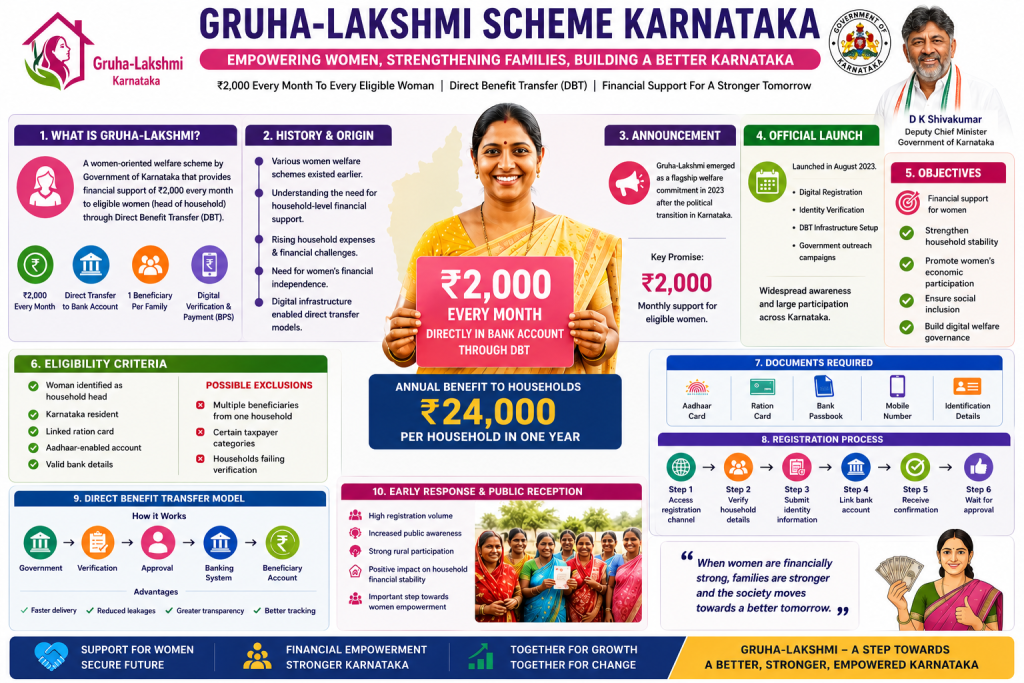
Gruha-Lakshmi scheme introduced for women by the Government of Karnataka to deliver financial support through Direct Beneficiary Transfer (DBT) to women of their households.
The Gruha-Lakshmi scheme provides:
- • ₹2,000 every month
- • Direct amount Transfer to beneficiary bank account
- • 1 beneficiary per individual family
- • Online Digitally verification and digital payment system (BPS)
Annual benefit To Households :
₹24,000 per household in one year.
The programme was designed with the hope that boosting women’s financial strength creates entire families’ financial stability .
Chapter 2: History and Origin of the Gruha-Lakshmi Scheme
Earlier also Karnataka government has implemented the women’s welfare scheme to make sustainability in the women’s income through various govt schemes but this Gruha-Lakshmi Scheme has its own imperative impact on women’s living standards, it has made women independent & economically sustainable.
Karnataka Government opted this approach by making understanding a household-level financial support system head of the family .
Economics realities which have impacted & influenced to adopt the Gruha–Lakshmi Scheme scheme
Rising Household Expensess
Most Families faced increase in expenses for:
- Food
- Education
- Utility Items
- Health & Medication
- Transportation
Conjusted Independence In Financial MATTERS
Many individuals contribute to their family in financial term but somewhere it has lack in backup of the independent financial status
Expanding Governance-Digital Government
Digital identity systems and banking infrastructure made direct transfer models more feasible.
These factors contributed to the development of Gruha-Lakshmi.
Chapter 3: Announcement of Gruha-Lakshmi
Gruha-Lakshmi emerged as a flagship welfare commitment during Karnataka’s political transition in 2023.
After government formation, implementation planning focused on:
- Database preparation
- Eligibility verification
- Banking integration
- Technology infrastructure
- Registration systems
The scheme attracted national attention because of its scale and expected beneficiary numbers.
Key promise:
₹2,000 monthly support for eligible women.
Chapter 4: Official Launch and Rollout
Gruha-Lakshmi officially launched in August 2023.
The rollout included:
Digital Registration
Applications became available through online and assisted channels.
Identity Verification
Beneficiaries were linked using:
- Aadhaar
- Ration card details
- Bank account verification
Direct Transfer Infrastructure
Monthly transfers were enabled through DBT systems.
Government outreach campaigns increased awareness in urban and rural regions.
Chapter 5: Objectives of Gruha-Lakshmi Scheme
The scheme was designed around several long-term objectives.
1. Financial Support for Women
Monthly assistance creates a predictable source of household income.
2. Household Stability
Regular transfers help families manage recurring expenses.
3. Women’s Economic Participation
Financial access can improve independence and decision-making.
4. Social Inclusion
The scheme aims to ensure support reaches women directly.
5. Digital Welfare Governance
Technology reduces dependency on intermediaries.
Chapter 6: Eligibility Criteria for Gruha-Lakshmi Karnataka
Eligibility is based on government rules and verification systems.
Generally eligible:
- Woman identified as household head
- Karnataka resident
- Linked ration card
- Aadhaar-enabled account
- Valid bank details
Possible exclusions may include:
- Multiple beneficiaries from one household
- Certain taxpayer categories
- Households failing verification
Eligibility rules may change based on government notifications.
Chapter 7: Documents Required
Applicants generally prepare:
- Aadhaar card
- Ration card
- Bank passbook
- Mobile number
- Identification details
Maintaining correct records helps reduce payment delays.
Read Also : Softwere Jobs At Banglore >> Apply Now
Chapter 8: Registration Process
Registration generally follows these steps:
Step 1: Access registration channel
Step 2: Verify household details
Step 3: Submit identity information
Step 4: Link bank account
Step 5: Receive confirmation
Step 6: Wait for approval
Registration simplification contributed to large-scale participation.
Chapter 9: Direct Benefit Transfer Model
DBT forms the operational foundation of Gruha-Lakshmi.
How it works:
Government → Verification → Approval → Banking System → Beneficiary Account
Advantages:
- Faster delivery
- Reduced leakages
- Greater transparency
- Better tracking
Chapter 10: Early Response and Public Reception
After launch, the programme received strong public attention.
Early observations included:
- High registration volume
- Increased public awareness
- Strong rural participation
- Greater discussion around women-led financial support
For many households, the scheme became an additional monthly income source.