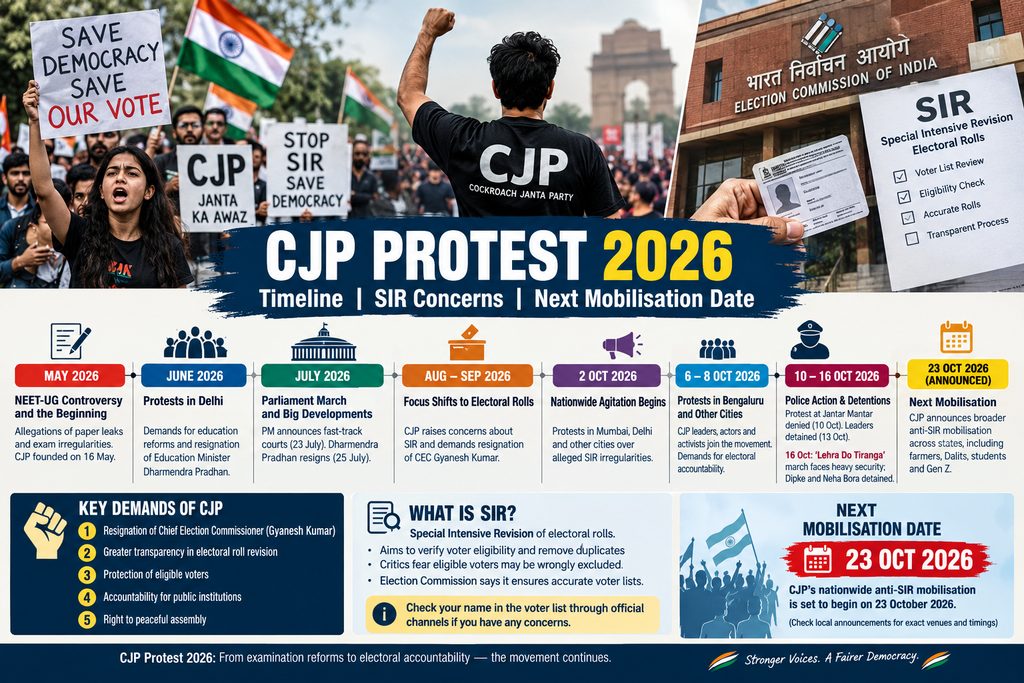
The Cockroach Janta Party (CJP) has become a prominent name in India’s 2026 protest movement. What began with anger over examination irregularities and the NEET-UG paper leak developed into a wider campaign for accountability. More recently, the movement has focused on electoral roll revisions, the role of the Election Commission and the right to hold peaceful demonstrations.
Led by founder Abhijeet Dipke, CJP has organised or called for protests in several cities. Its activities have also drawn attention to questions about police permissions, detentions, public demonstrations and the political debate surrounding the Special Intensive Revision (SIR) of voter lists.
Here is a chronological look at how the movement developed, what happened during the recent protests and what is known about the next announced phase.
What Is CJP?
CJP stands for Cockroach Janta Party, a youth-led political movement associated with Abhijeet Dipke. Its activities in 2026 initially centred on examination-related grievances, particularly the controversy surrounding the NEET-UG examination.
The movement later expanded its campaign to include electoral issues and demands for accountability from public authorities. Its founder and supporters have called for changes to examination systems, questioned the handling of voter-list revisions and demanded the resignation of Chief Election Commissioner Gyanesh Kumar.
The movement’s demands and the government’s position differ on several important questions. The Election Commission has defended the voter-list revision exercise, saying it is intended to identify eligible voters and remove duplicate or ineligible entries. Critics, including protest organisers and opposition parties, have raised concerns about possible wrongful deletions.
Understanding this distinction is important when following the CJP protests: the events themselves, the demands made by organisers and the responses from authorities are separate parts of the story.
CJP Protest Timeline: From May to October 2026
May 2026: The movement emerges amid the NEET controversy.
The first major phase of the CJP story was connected to anger over examination integrity and allegations surrounding the NEET-UG examination.
NEET is a crucial entrance examination for students seeking admission to medical courses in India. Questions about examination security, fairness and the consequences of alleged irregularities can have a significant impact on students and their families.
According to an NDTV timeline published on 25 July 2026, NEET-UG was conducted on 3 May, and the examination was cancelled on 12 May amid paper-leak allegations. The same report identifies 16 May as the date when Abhijeet Dipke founded the Cockroach Janta Party platform.
The controversy provided the background for a youth-led campaign demanding accountability and improvements to the examination system.Why this phase mattered: It established examination fairness and government accountability as central themes in the movement’s early activities.
June 2026: Street protests and demands for examination reform.
In June, the movement shifted from online criticism and public statements towards street demonstrations.The NDTV timeline records that Dipke returned to India in early June to lead a protest in New Delhi, with demonstrators demanding the resignation of then Education Minister Dharmendra Pradhan.
On 11 June, CJP released a five-point manifesto calling for reforms to the examination system. On 20 June, the movement launched an indefinite protest at Jantar Mantar in Delhi.Jantar Mantar has historically been a location for public demonstrations and political campaigns. The protest brought the movement’s demands into a more visible public setting.
The central questions included examination security, responsibility for alleged irregularities and what measures should be taken to restore confidence among students.For many students, the examination controversy was not simply a political issue.
Competitive examinations influence years of preparation, family finances and future career opportunities. Any alleged failure in the process can therefore generate widespread public concern.
July 2026: Parliament march and a major political Developments
July became a significant month in the movement’s first phase.According to the NDTV chronology, CJP announced a Parliament march for 9 July.
The campaign continued during the Monsoon Session period, and a large mobilisation took place on 20 July.The march was followed by police action and further political developments. The report also records discussions between government representatives and CJP members during this period.
The protest movement continued to demand accountability over the examination controversy, while the government faced pressure from opposition parties over the issue.
On 23 July, Prime Minister Narendra Modi announced fast-track courts to deal with examination paper-leak cases, according to NDTV’s timeline. Further discussions took place the following day.On 25 July, Dharmendra Pradhan resigned as Education Minister.
The timing made the resignation a major development in the broader examination controversy. However, it is important not to assume that a single protest or organisation alone caused a minister’s resignation; the wider controversy and political circumstances also formed part of the background.
Key takeaway: The May–July phase brought CJP’s examination-related campaign into national political discussion and helped establish its profile as a youth-led protest movement.